Going First
This fall I teach my first course for academic credit: a hundred students learning to say what they can do, with receipts.
This fall, for the first time in my career, I'm teaching a course for academic credit.
I've spent ten years building education for other people to deliver—programs, certifications, workforce training, whole divisions of it. This one I built myself, start to finish, and this one I'm teaching myself. A hundred students. Fully online. A course called From Transcript to Track Record.
Here's why it exists.
A transcript records what you took. It says nothing about what you can actually do. And almost nobody is ever taught to close that gap. I've watched it for years—capable people, people with real skills, freezing when someone asks the simplest question in the world: What are you good at? They don't freeze because they can't do the work. They freeze because no one ever taught them to say what they can do.
Some people pick that language up at home, around dinner tables where careers get talked about like weather. Plenty of people don't. The ones who don't get evaluated on it anyway—in interviews, in reviews, in every room where someone is deciding whether to bet on them. I don't think that's fair. I do think it's teachable. So I built a course that teaches it out loud, for credit.
The way I put it to my students: articulate your skills so you can pay your bills.
And here's the part that has me excited. The skills this course works with get called "soft skills." Ask anyone who hires which ones are hardest to find. I'd call them what they are: liberal arts skills—the durable kind—and they never work alone. They work in concert with industry knowledge and lived experience, layers of learning that keep stacking for as long as you keep living. I've spent a decade standing between higher education and industry, and here's what I know: they care about the same things. They just speak different languages. This course is a translation project. And translation is the work I know best.
Why I built it the way I did
The course works like a series of coaching sessions because a coach doesn't tell you who you are. A coach asks good questions, and you find the answer—and what you find for yourself, you keep. I'm not going to lecture a hundred adults about their own lives. They're the experts on that material. My job is to hand them the questions.
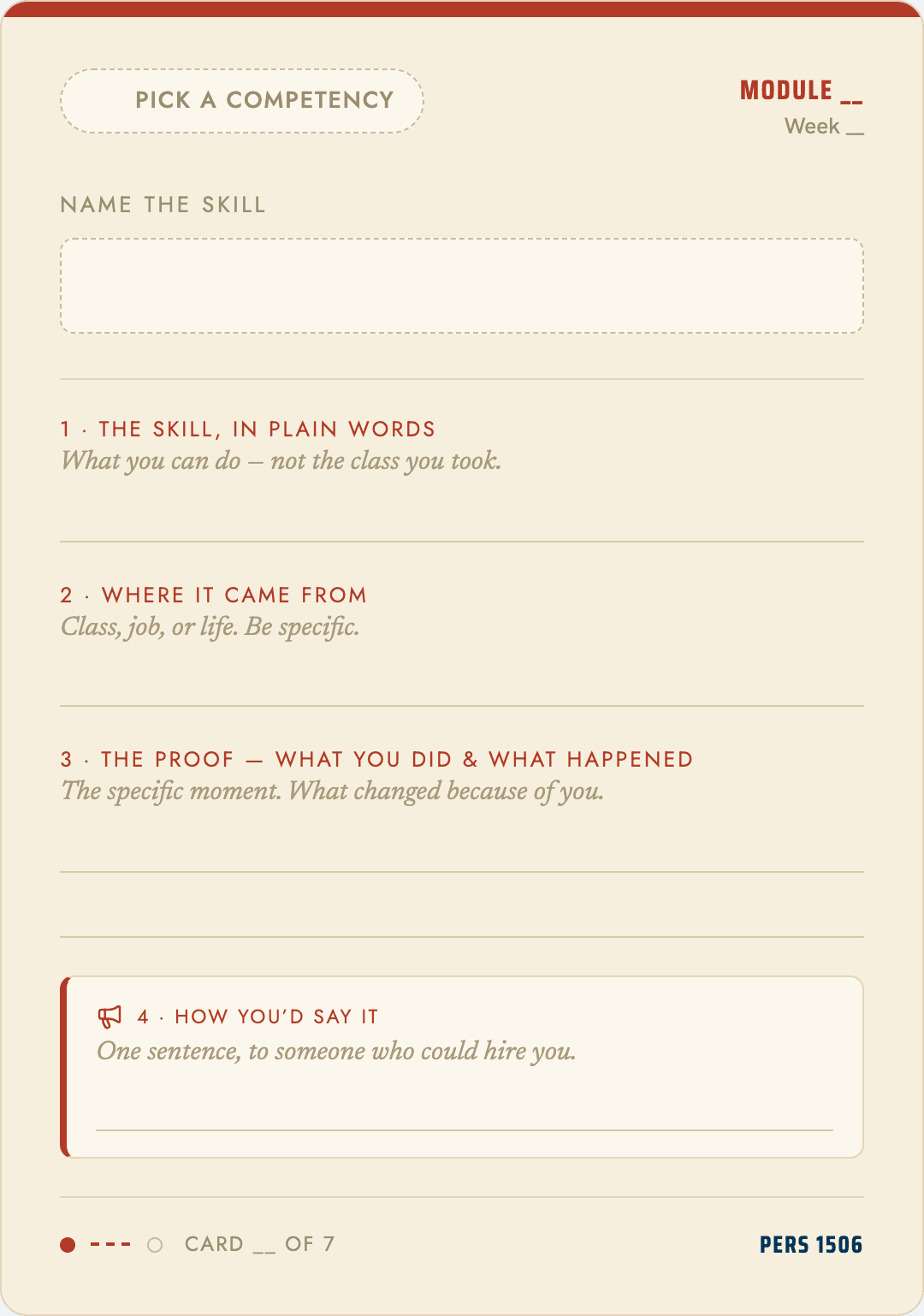
It teaches one move, over and over: see a real skill, name it in plain language a hiring manager would recognize, and prove it out loud with a specific moment only you were there for. Not once—again and again, until it stops being a performance and starts being a reflex. The videos are thirty seconds long and re-recordable, on purpose. You get better at saying things out loud by saying things out loud, in a place where it's safe to be bad at it first.
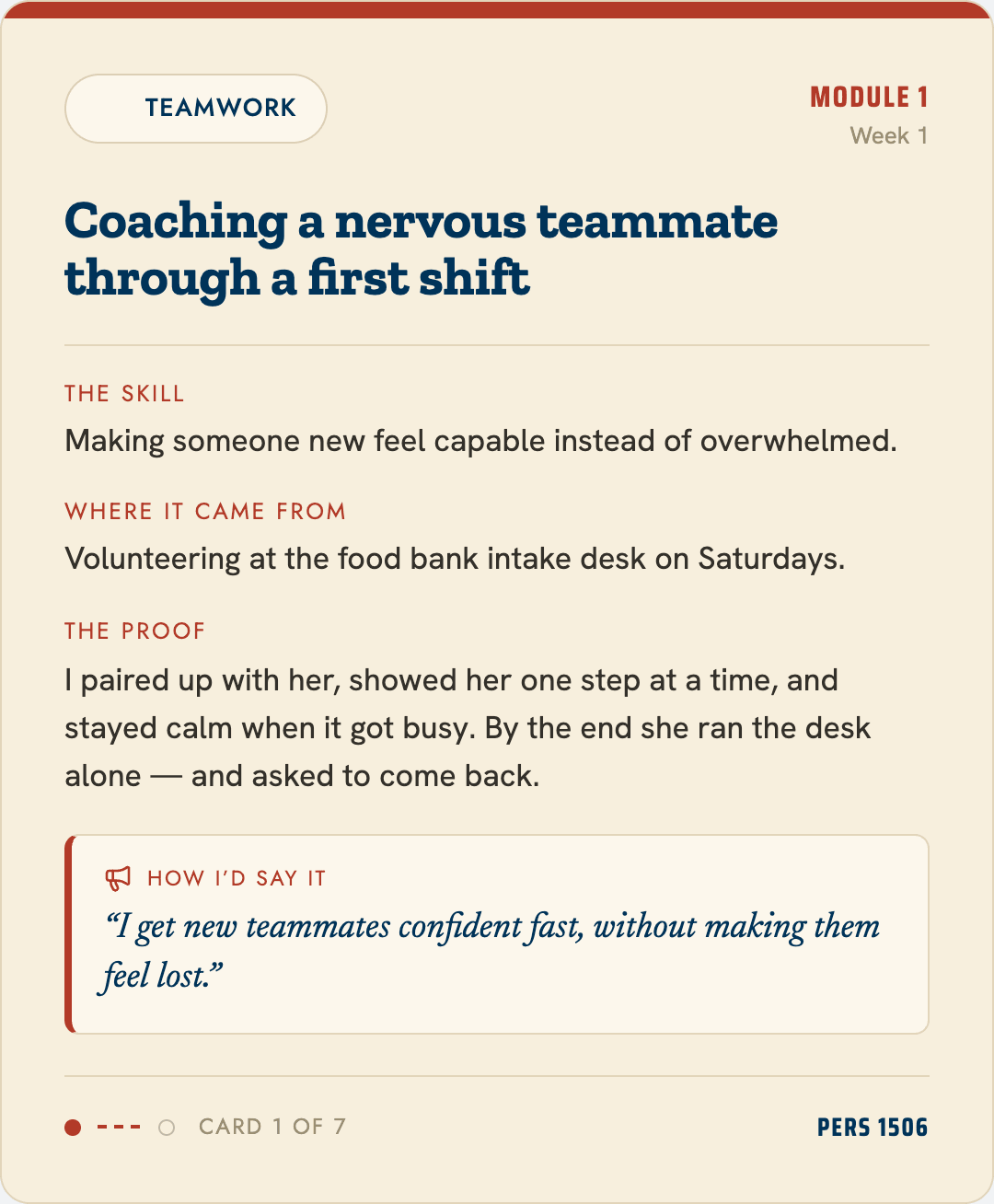
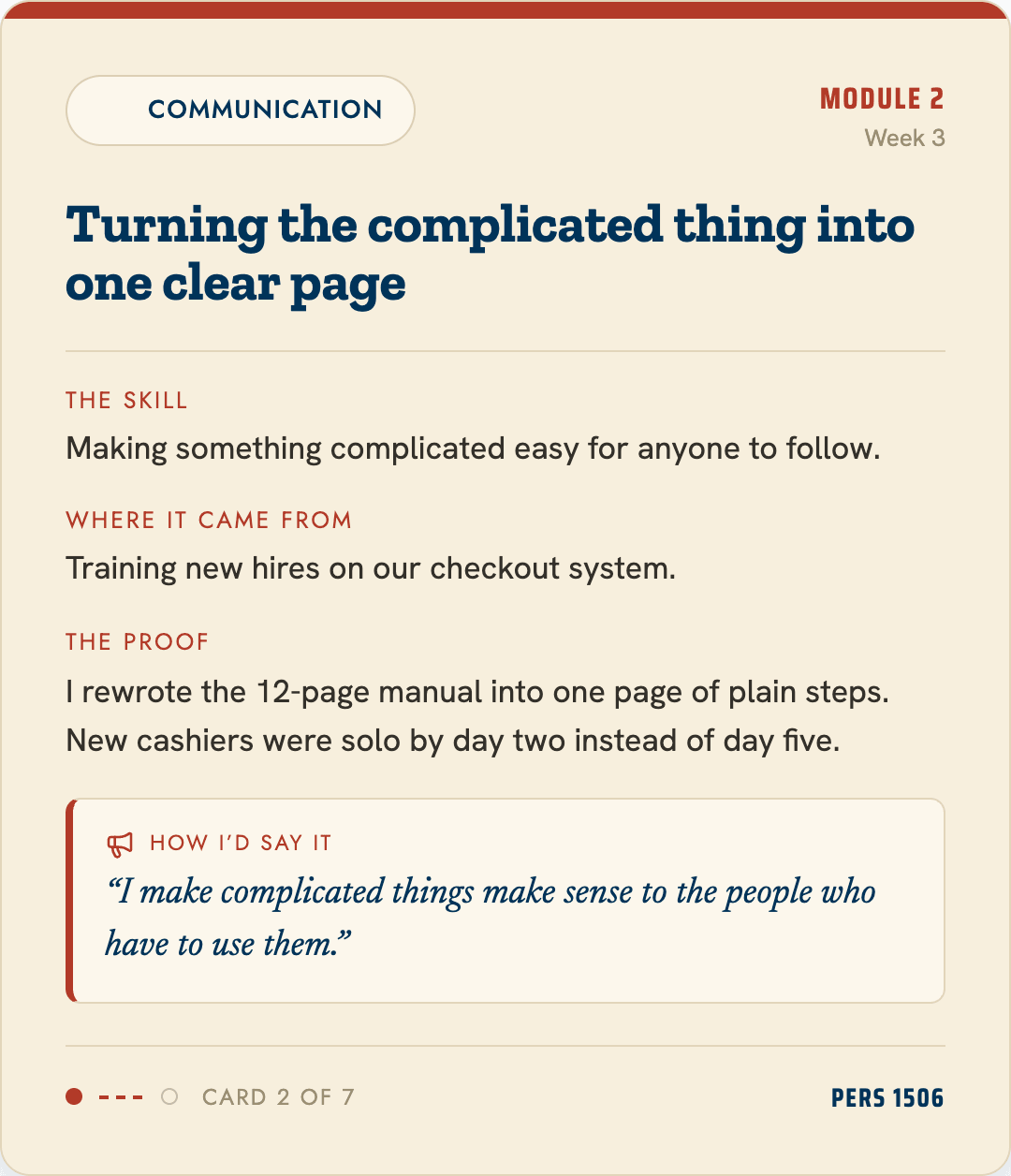
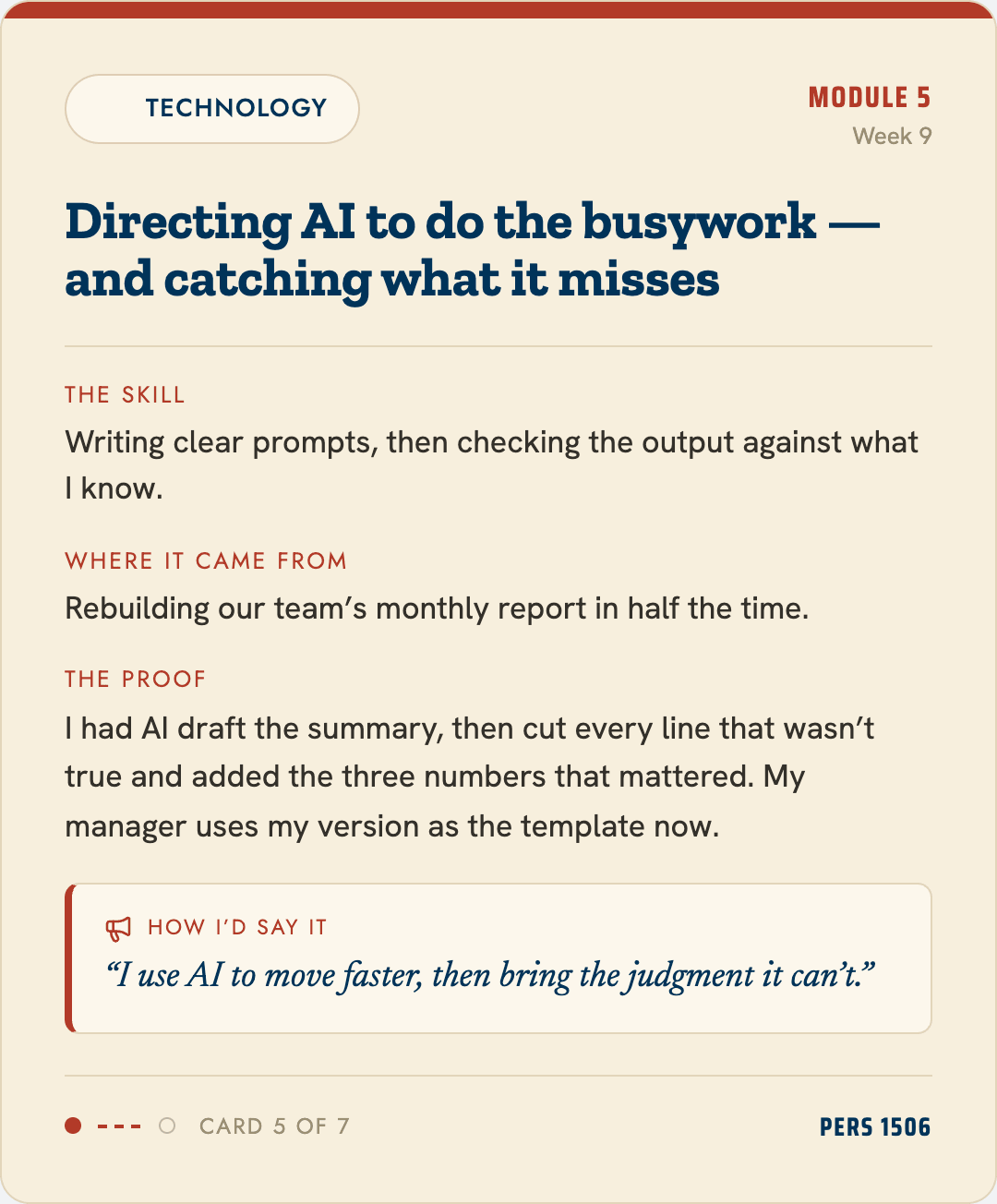
The rule underneath everything is simple: no adjectives without receipts. Anyone can claim a skill—claims are free. The specific moment, the thing that actually happened, is what makes a skill yours. So the course is skeptical in the kindest possible way. It never asks a student to believe something flattering about themselves. It only ever asks them to prove something true.
And yes—the students use AI, on purpose, out in the open. Twice, they have an AI tool write a generic version of themselves. Then they cross out every line that isn't specifically true and replace it with a real moment only they have. The generic version isn't wrong, exactly. It's unowned. Learning to tell the difference between smooth and true—that's not a workaround for the AI era. That's the skill the AI era runs on.
What I hope it does
I hope a hundred people walk out of this course able to account for themselves. Not perform. Account. I hope the student who's been raising kids while finishing a degree learns to say "project management" without apologizing for where she learned it. I hope the one who talked two coworkers off a ledge during a brutal shift realizes that what they did has a name, and the name is worth money. I hope the question "Tell me about a time you failed" stops being the one they dread and starts being the one they're ready for.
A transcript sits locked in a registrar's office. What they build in this course goes wherever they go. That's the whole trade.
What I hope to learn
Here's the part I say less often: I've never done this before. I've taught in plenty of rooms—corporate trainings, certification prep, a prison classroom—but never for credit, and never a course I designed alone. I built the thing. Now I find out what it does.
So I'm walking in as a student of my own course, and I have real questions.
I want to know where they freeze—whether the hard part is seeing the skill, naming it, or saying it to another human being. I designed for all three; the students will tell me which one is the real wall.
I want to know what shows up that I never planned for. A hundred adults, each naming seven skills—that's seven hundred small claims about what people can actually do. I guarantee some of them will be skills I'd never have thought to put on a list, drawn from lives nothing like mine. That inventory will teach me more about what my students carry than any needs assessment I could run.
I want to know if the AI exercise really teaches discernment—whether students start to notice, on their own, that the borrowed lines all sound alike and the true ones sound like exactly one person. If that instinct transfers past my course, it might be the most durable thing I teach.
And I want to know what I'd rebuild. Somewhere in these fifteen weeks is the thing I got wrong—an assignment that lands flat, a question that doesn't open anyone up. Finding it is not a risk of teaching this course. It's one of the reasons to.
The course asks every student to stand up and say: here's what I can do, here's the proof, and here's why it matters. It seemed only fair to go first.
This is my card. Ask me in December what I learned.
Samantha Miller Gurski is Director of Continuing & Professional Education at Columbus State University and the creator and instructor of PERS 1506: From Transcript to Track Record. The report that became the course is available here.